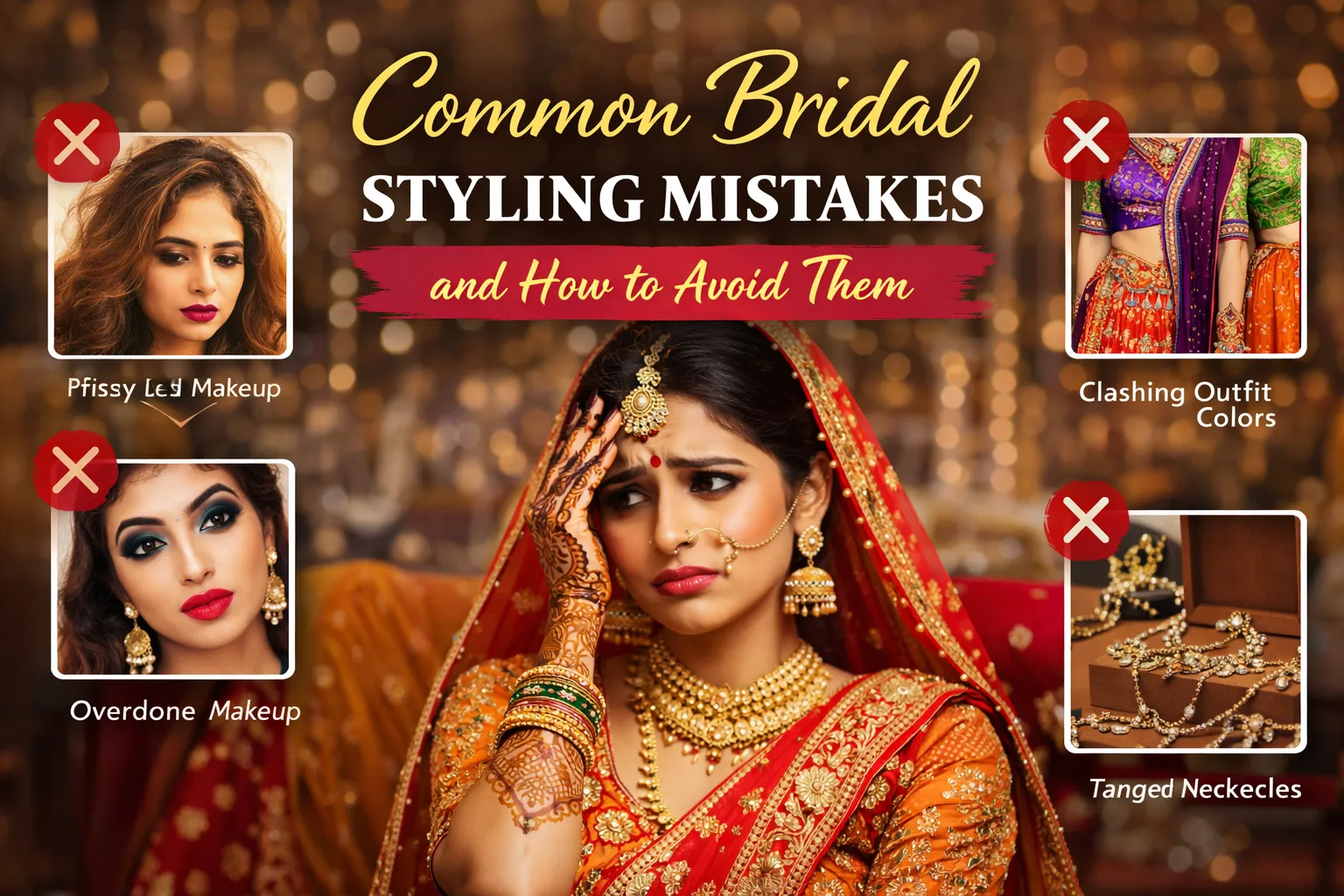
Your wedding day is the one moment when every eye is on you. You want to feel like the most beautiful version of yourself, not like you’re fighting your own outfit. Yet, every season I see the same bridal styling mistakes that turn dream looks into stress. As someone who has styled hundreds of brides for Sajani Collection, I’m here to help you skip those pitfalls and walk down the aisle feeling calm, confident, and completely you.
Here are the 10 most common bridal styling mistakes I still see in 2024–2025, and exactly how to avoid them.
1. Wearing Too Much Jewelry
Heavy necklace + huge earrings + maang tikka + hathphool + bangles + nose ring = you can’t move your neck or smile properly.
How to avoid it:
Pick one statement piece and keep the rest minimal. If your neckpiece is heavy, skip the maang tikka or go for a tiny borla. If you’re wearing a big jhumka, skip the necklace and choose a delicate pendant or just a choker. Trust me, your face will thank you in the photos.
2. Choosing the Wrong Fabric for the Season
Wearing heavy Kanjeevaram silk in May or lightweight georgette in December is a recipe for disaster.
Quick guide:
Summer/day weddings → Banarasi organza, chiffon, light silk cotton, tissue silk
Winter/evening weddings → Velvet, raw silk, brocade, heavy Banarasi
Monsoon → Avoid pure silk (zari gets damaged with water splashes); go for synthetic blends or tussar.
3. Getting the Blouse Fit Wrong
Too tight = you can’t breathe during the pheras.
Too loose = constant tugging in photos.
Golden rule: Your blouse should let you raise your arms comfortably for the jaimala and still look sharp. Always do the “arm test” during trials – lift both arms like you’re garlanding the groom. If it pulls or digs in, ask for alterations.
4. Overdoing the Makeup
Heavy contour + dark lips + smoky eyes + full-coverage foundation in Indian lighting = you look orange or grey in photos.
What actually works:
- Medium coverage foundation with one shade lighter concealer only where needed
- Soft rosy-brown or peach blush (never red if you’re wearing red lipstick)
- Waterproof kajal + mascara (because happy tears are guaranteed)
- Soft pink/nude or rose-brown lipstick that stays within 2 shades of your natural lip color
Let your skin breathe. The camera loves glow, not layers.
5. Ignoring Your Body Shape
Hourglass brides wearing straight-cut lehengas or apple-shaped brides choosing heavy hip embroidery – both end up hiding their best features.
Simple fixes:
Petite → high waist lehenga + small border
Tall → wide borders + low waist
Heavy bust → broad necklines (square, scoop, or wide V)
Heavy hips → A-line or panelled lehengas, not mermaid styles.
6. Mismatched Dupatta Styling
One dupatta falling off every two minutes or two dupattas making you look like a gift-wrapped package.
Best ways I style brides now:
- Single dupatta: pleat and pin on left shoulder + tuck lightly at waist
- Double dupatta: lighter one on head (pinned at crown), heavier one on shoulders with minimal pleats
Pro tip: Use tiny safety pins inside the blouse or petticoat – no one will see them.
7. Choosing Trends Over Comfort
2024’s hottest trend might be corset blouses or 15-kilo lehengas, but if you can’t sit or eat, you’ll hate every photo after the first hour.
Ask yourself: “Can I hug my grandmother comfortably? Can I sit on the floor for the vidaai?” If the answer is no, skip it.
8. Last-Minute Shopping or Alterations
Buying your lehenga 20 days before the wedding or getting final alterations 2 days before = panic mode.
Ideal timeline:
6–8 months before → finalise outfit
3 months before → first trial + alterations booked
1 month before → final fitting
1 week before → steaming only, no major changes.
9. Not Doing a Hair & Makeup Trial with the Exact Dupatta
Many brides do trials with open hair, then wear a heavy dupatta on the wedding day and suddenly the entire look changes.
Always bring your real dupatta and jewelry to the trial. Take photos in natural daylight and golden hour lighting – that’s what your photographer will use.
10. Forgetting the “After-Party” Outfit Change
You spend lakhs on the wedding lehenga but wear the same heavy outfit to the reception and look exhausted by 10 p.m.
Smart brides now plan two looks:
Wedding → traditional heavy lehenga/saree
Reception → lighter anarkali, pre-draped saree, or cocktail lehenga that lets you dance.
Quick Comparison Table: Heavy vs Light Bridal Looks
| Aspect | Heavy Traditional Look | Light Modern Look |
|---|---|---|
| Weight | 8–15 kg | 3–6 kg |
| Comfort level | Low (hard to move after 2 hours) | High (can dance all night) |
| Best for | Temple weddings, winter | Summer, destination, reception |
| Photo result | Grand but tiring | Fresh throughout the day |
| Cost | Higher (heavy zari) | Usually lower |
Things to Consider Before Buying Your Bridal Outfit
- Budget: Keep 40% buffer for alterations, innerwear, and steaming
- Versatility: Can you wear the dupatta or blouse again?
- Family sentiment: If your mom wants you in red, maybe choose wine red instead of fighting for pastel
- Photographer’s advice: Ask them which colors pop best in their style
Care & Maintenance Tips for Your Bridal Saree/Lehenga
- Never dry clean before the wedding (chemicals can dull zari)
- Get it dry-cleaned only after all functions are over
- Store in muslin cloth, not plastic
- Hang heavy lehengas instead of folding to avoid permanent creases
- Keep silica gel packets inside to prevent moisture
Frequently Asked Questions
- Can I wear pastel for my wedding?
Yes! Pastels are very in, just add a heavy dupatta or contrasting jewelry so you don’t look washed out. - Should I match my outfit exactly with the groom?
Coordinated, not identical. Same color family or complementary shades look classy. - Is it okay to wear a ready-to-wear saree for the wedding?
Absolutely. Modern pre-stitched sarees are a blessing if you’re not comfortable with draping. - How heavy should my bridal lehenga be?
Anything above 10 kg is risky unless you’re used to carrying weight. Most of my brides now choose 5–7 kg. - Can I reuse my bridal lehenga for future events?
Choose detachable layers or convertible styles – many designers now offer lehengas that turn into sarees or gowns.
Your wedding look should make you feel like the best version of yourself, not a mannequin carrying someone else’s dream. Avoid these common bridal styling mistakes, trust your instincts, and remember – the most beautiful brides are the ones who look happy and comfortable in their own skin.
You’ve got this. Walk down that aisle like you already own the room – because you do.